




Marc Köhlbrugge
PRO
@marc
When you say localized pricing does that include discounting the price based on purchasing power? Or just a currency exchange?
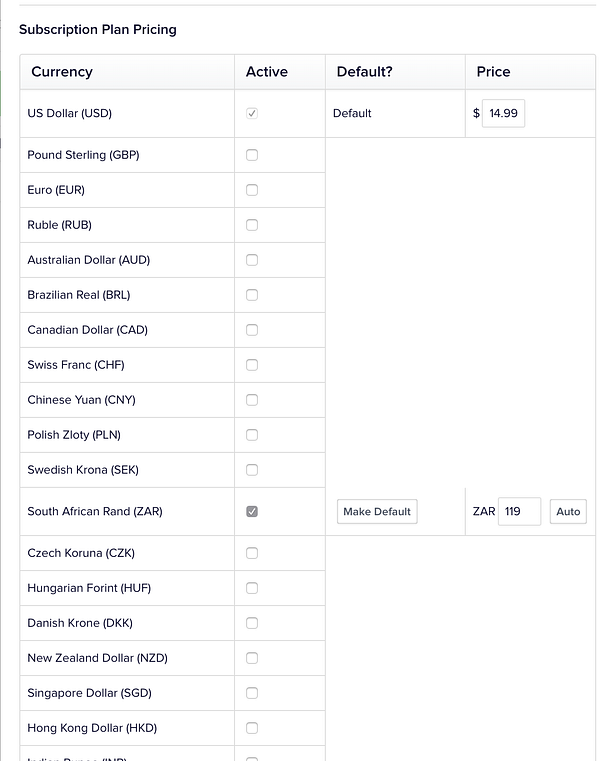
Like you can set a price for each currency. In this example it would be 119 ZAR (± $10) for SA based users and the rest of the world would see 14.99 USD.
I see. That’s handy!
Also services like Spotify localise their pricing for exactly the same service.. Like in the US it's $10, 10 pounds in the UK and 10 EUR in Europe.. And then, R60 (±4 Euros) in SA and I think in SE Asia like Thailand and the Philippines it's even cheaper.
It all depends on the audiences. If the product audience is a one-on-one match with your personal account then there's an argument to be made to just use your personal account. In most cases however, you're probably better of creating a separate account and retweeting where relevant.
I have a couple of dozen Twitter accounts and only have one mobile phone number. I think you can skip this phone number step during sign up process. It's not very obvious, but I think it's possible. You can also skip the annoying onboarding wizard (that makes you try and follow a bunch of people) by just changing the URL to the Twitter homepage. It doesn't force you to complete signup wizard as long as you completed the basic steps such as choosing a username and email address.
One drawback of not adding a phone number is that your account is more likely to get suspended. This can even happen immediately after signing up without having tweeted anything. In that case you can appeal the suspension and explain why you had to create a separate business account and can't add a phone number since it's already linked to your main, personal account. If that account is in good standing, then you can expect your new account to be reactivated within a day or so.
For sure. Figuring out what pricing to use for which user is complicated. People travel, it’s hard to determine affluency on a country basis (I got offered a 30% discount for being in Korea???), location can be spoofed, etc.
I don’t think there’s a perfect approach, just like charging everyone the same absolute price isn’t necessarily perfect either (depending on your goals).
So I guess the question becomes what the least bad option is.
Ultimately it might come down to trust. For example with WIP I don’t see many affluent people abuse the system as it would look very bad on them if they get caught.
cc @levelsio – do you have any info on purchasing power for different countries? It would be interesting to offer this as a separate API for companies who want to provide price their products based on purchasing power.
Could you elaborate on what kind of guide you're writing, what help you need?
Hi Marc, I'm writing a guide for SMEs and startups. It is a basic guide meant for those with little knowledge of digital marketing but want to have all the essentials in one place. Here is the table of contents: workflowy.com/s/IOrs.VcJ3bpqc…. The thing is I'm building this in public and I want feedback on the structure and maybe things that could be addressed in such a guide but didn't cross my mind. Here's the guide: docs.google.com/document/d/1_…
Thanks
It's difficult to learn something if you don't have an immediate need for it.
Can you think of any apps that could substantially improve your parents' lives? For example, if they like to travel but still use travel agencies you could introduce them to Airbnb, Booking.com, etc. If they are into history, set them up with a YouTube account that is subscribed to some interesting history channels, etc.
Ah yes, I already generate a policy so only signed in users can upload files to our S3 buckets. And files that aren't attached to a saved database entry (e.g. a comment) are automatically pruned.
So I think things are pretty safe as is. Just wondering if there are any best practices otherwise.
I see. That’s handy!
Also services like Spotify localise their pricing for exactly the same service.. Like in the US it's $10, 10 pounds in the UK and 10 EUR in Europe.. And then, R60 (±4 Euros) in SA and I think in SE Asia like Thailand and the Philippines it's even cheaper.