




It really depends on your goals.
Assuming the previews provide enough information to convince people to sign up, your conversion rate would likely increase if you require sign up.
Long term though, it might have some drawbacks. Google would have less content to index, so you might not get as much search traffic. Fewer people might end up sharing the pages, because they might see only the preview, not bother to signup, and not share the page.
At the early stage I would lean towards making it public. It increases your "luck surface area" as more people will see your content, it likely will get shared more frequently, etc. Have a look at @harrydry's marketingexamples.com on how you can still build a mailing list while providing the content publicly. (Both his own site, and some of his case studies are worth a look.)
I think it's unethical if your reason for linking is financially motivated, but it's not obvious from the context. In that case you're intentionally deceitful.
If you would have linked to it regardless of the financial incentive (i.e. even if they didn't have an affiliate program), then I'm not sure I'd consider it unethical, but I still highly recommend disclosing it.
I don't tend to use affiliate links because they come across disingenuous even if they are not. In the exceptions I do use affiliate links, I clearly disclose it and often add a non-affiliate link as well so people have an option.
I’ve never heard them being combined. How do you decide when to use which? Or is it more of a progression from one to other?
I almost exclusively use Tailwind with @apply, sometimes I first try it out on the HTML and then copy it to a dedicated class.
Doing it like this forces me to write more logical CSS and be more DRY (for example having consistent logical margins instead of just adjusting arbitrary elements until it looks good)
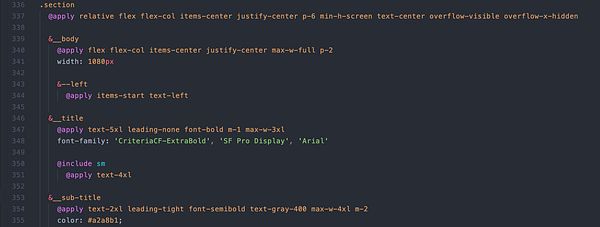
I'm indeed writing my own CSS using the BEM approach. I'm not crazy about it, but it definitely beats my old way of doing things which lacked any structure at all. At least BEM provides some general strategy.
Lately I'm becoming more intrigued by utility-first CSS frameworks like Tailwind CSS. I have yet to actually try it though, but the overall concept makes a lot of sense. Especially after reading this article.
I've also heard a lot of good things about it. @Jankeesvw, do you mind chiming in with your experience?
If I do this users who share their nl url with someone from en the en user
will visit the wrong page.
I think this is true for any page, correct? If I as a Dutch user visit your site and up tweeting a link, my Twitter followers will end up on a Dutch page. Correct?
I'd lean towards using a URL parameter even though Google recommends against it. The cons they explain don't include bad SEO ranking as far as I can tell. Personally, I could live with the cons. Also, since your site doesn't seem to be content-heavy and the language setting tends to refer mostly to user interface elements (I think?) I don't think it's much of an issue anyway.
I also recommend looking at how other sites have solved this. Specifically those that have a similar setup as yours. (user generated content, etc)
Currently I'm working on a v2 of sayhi.dog and it includes breed pages where a lot of content has been created (by the community). So it will be content heavy and those pages are going to be very different for several languages. It's a difficult decision but I will do some more research.
Thanks for answering Marc!
I don't ship a v1, I ship a v0.1
Basically I try to ship something as soon as possible. Within the first 24 hours if possible. Call it a v0.1, a prototype, alpha version, whatever you want. But ship something public-facing as quickly as possible.
This will both start building your momentum, and force you to iterate quickly on the things that matter.
The reason for your analysis paralysis is probably because you feel like your product is "not good enough to launch". That's your pride talking. You know you can do better than this and you don't want people to think you missed that one bug, or overlooked that typo.
The truth is a product is never finished, so it's never "good enough" to launch. But you can use that feeling to your advantage. By shipping something you're embarrassed of and then quickly fixing all the things as people point them out to you.
That's what I do with my products. WIP still has many bugs and defects I am 100% aware of and slightly embarrassed of. However, that didn't keep me from shipping it. I just push it live, find out what the biggest shortcomings are (they aren't always the things you expect), and then fix those as I go along.
It keeps the momentum going, forces you to focus on the parts that matter, and be efficient in how you spend your time.
Thank you for taking time to respond the question. You shared some very good pointers on how I should be looking at my products rather than going in spirals of due diligence.
Looking from the lens of v0.1 is far more achievable instead of aiming of v1.
I'm making your this answer my manifesto of launching products going forward. Cheers!